
DATE/TIME
Date(s) - 04/16/2026
8:00 am - 3:00 pm
LOCATION
Connecticut College
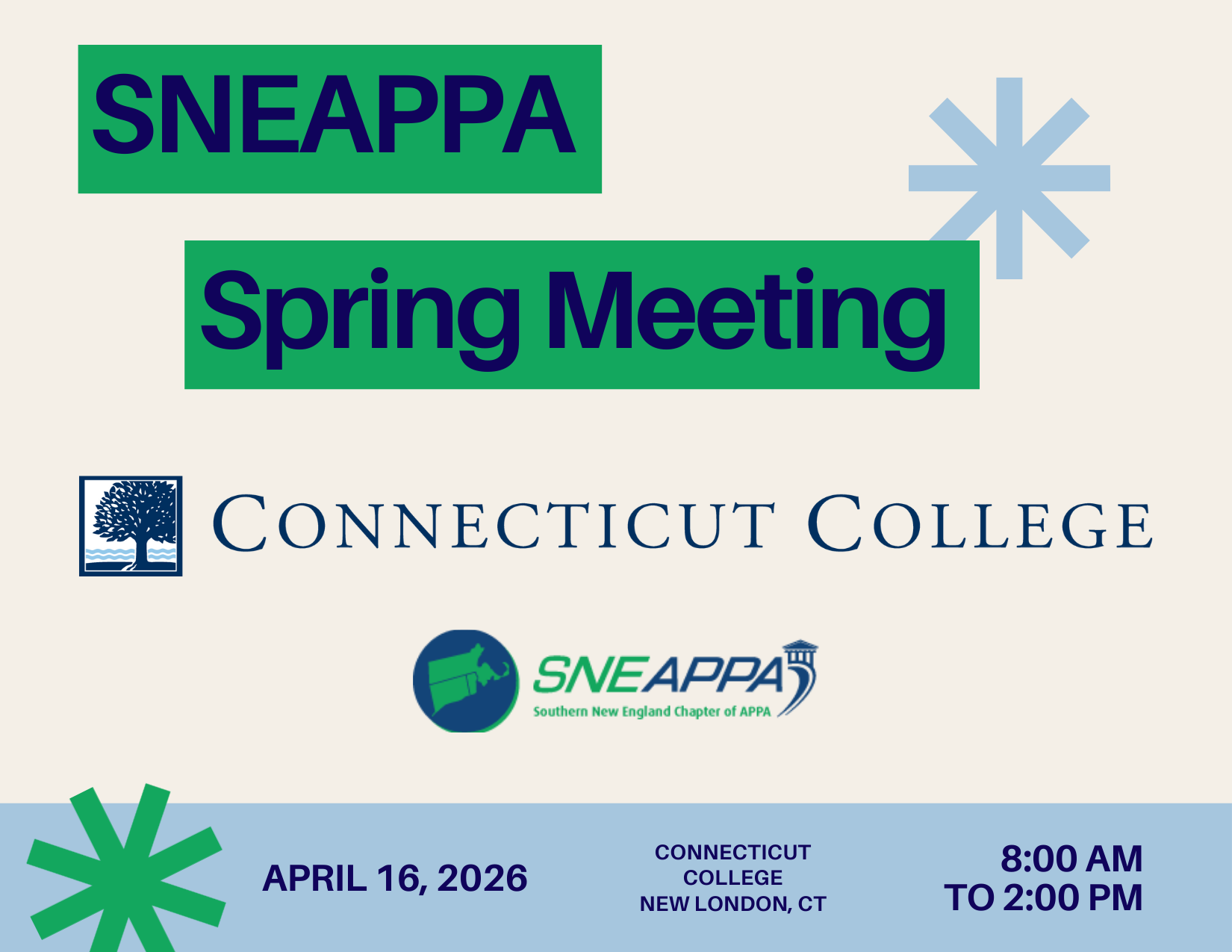
Save the Date for SNEAPPA’s Spring Meeting!
Join us for SNEAPPA’s Spring Meeting at Connecticut College in New London, CT on April 16, 2026. Enjoy an engaging educational program exploring innovative strategies shaping today’s academic campuses, featuring real-world case studies from Connecticut College.
This meeting brings together industry leaders to tackle three critical areas of campus planning and facilities management. Learn how to successfully execute complex renovations in fully occupied academic buildings, balancing construction progress with uninterrupted campus life. Discover how a people-first approach to pedestrian design can transform movement, safety, and sustainability while addressing the “Parking Paradox.” Finally, explore how facilities data can evolve from a static maintenance report into a powerful strategic tool that aligns capital planning with institutional mission and long-term success.
Attendees will gain practical insights into phasing and disruption mitigation, universal and resilient campus design, and leveraging data visualization and cross-functional collaboration to secure leadership buy-in. Whether you’re managing projects, shaping campus environments, or planning for the future, this program offers actionable strategies to strengthen and sustain your institution.
Program Descriptions
Open-Heart Surgery on an Awake Patient: Mastering Renovations in Occupied Academic Buildings
Presented by Josh Sylvester, Regional Direct and Aaron Kreuger, Senior Project Superintendent, from Coinsigli Construction Co., we will focus on renovating occupied campus buildings. Renovating a higher education facility is complex; renovating one while it remains fully occupied is akin to performing open-heart surgery while the patient continues their daily life. Using recent projects at Connecticut College as a case study, this session explores the strategic planning required to balance construction velocity with academic continuity.
We will move beyond basic project management to discuss the specific tactics that make occupied renovations survivable and successful. From establishing “quiet hours” that align with class schedules to implementing a “24-hour rule” for faculty communication, attendees will learn how to mitigate the physical and operational impacts of construction. The presentation will cover the “Four Pillars” of occupied renovation: smart phasing, physical barrier management (noise/dust), stakeholder communication, and rigorous safety compliance.
- Key Takeaways:
- Phasing Strategy: How to conduct pre-construction walkthroughs to identify “safe” zones and build realistic buffer times.
- Disruption Mitigation: Practical solutions for noise, dust, and swing-space limitations, including HEPA filtration and modular units.
- Stakeholder Trust: implementing effective communication loops, including QR code dashboards and town halls to preempt frustration.
- Safety & Code: Managing egress routes, fire alarm impairments, and “curiosity hazards” in populated student zones.
Rethinking Pedestrian Design & Campus Movement: A People-First Approach
Presented by Kaki Martin, landscape architect from Klopfer Martin Design Group and Steve O’Neill, Principal and Director of Transportation Engineering and Rod Szwelicki, Senior Project Manager and the Institutional Practice Lead at VHB, this session explores how to balance the “Parking Paradox” with the need for open, accessible spaces.
Modern campuses are shifting from car-dominated grids to social, multimodal ecosystems. However, creating a walkable campus requires more than just adding sidewalks; it demands a fundamental rethinking of how people, vehicles, and nature interact. We will examine the campus through a holistic lens, discussing how to transform movement networks into assets that enhance safety, sustainability, and campus identity. From analyzing “desire lines” to predict human behavior, to pushing parking to the perimeter, attendees will learn strategies to reduce conflict points between vehicles and pedestrians. The presentation will also cover the integration of stormwater management into landscape design—turning necessary infrastructure into visual amenities—and the critical shift from basic ADA compliance to true Universal Design.
- Key Takeaways:
-
- The Parking Paradox: Strategies for right-sizing supply and repurposing lots into multi-use green spaces.
- Universal Design: Going beyond code compliance to create equitable, intuitive routes for all mobility levels.
- Resilience: How to use bioswales and permeable pavements to manage stormwater while beautifying pathways. Expanding on the College’s existing Sustainability Trail
From Spreadsheet to Strategy: Leveraging Facilities Data for Institutional Success
Presented by Tom Arcari, Principal and Erin Benken, architect, from Quisenberry Arcari Malik, we will focus on an institutional Facilities Condition Assessment (FCA). An FCA is merely a snapshot of deferred maintenance—a static list of “broken things.” But at Connecticut College, the FCA has been transformed into a dynamic, strategic asset that drives long-term planning. Presented in partnership with QA+M, this session explores how to elevate facilities data from operational noise to institutional priority.
We will examine the roadmap for building a cross-functional team—bridging the gap between Facilities, Finance, and Academics—to ensure capital decisions reflect the college’s mission, not just its maintenance needs. Attendees will learn how to translate raw technical data into “defensible” narratives for the Board of Trustees, using visualization tools and scenario planning to justify investment. Join us to see how a data-driven approach can secure leadership buy-in, reduce operational risk, and align campus stewardship with recruitment and retention goals.
- Key Takeaways:
- The Modern FCA: Moving beyond static reports to create a living, visual tool for capital planning.
- Data Visualization: Using dashboards and lifecycle models to “tell the story” to non-technical leadership.
- Silo-Busting: Strategies for building cross-functional teams that share ownership of campus stewardship.
- Scenario Planning: How to model 5-year plans and funding shifts to prepare for future uncertainties.
View the full program here.
Location & Parking Instructions
Connecticut College
Crozier-William, 1962 Room
270 Mohegan Avenue
New London, CT 06320